A corporate training LMS is used to organize employee learning across onboarding, compliance, skill development, leadership training, and certification management. At enterprise level, it replaces scattered tools and manual tracking with one centralized system that connects training to measurable business outcomes.
Corporate Training LMS Use Cases at a Glance
Most enterprise teams use an LMS for:
- Structured onboarding
- Compliance documentation
- Upskilling initiatives
- Leadership development
- Sales and product training
- Certification tracking
- Partner education
- Performance analytics
But the real value shows up when growth creates complexity.
What Is a Corporate Training LMS?
A corporate training LMS is not just software for uploading courses. It is operational infrastructure for workforce development.
Academic systems focus on grades and classrooms. Corporate systems focus on performance, accountability, and risk reduction.
In practical terms, it becomes:
- The place where onboarding lives
- The system that proves compliance
- The dashboard HR checks
- The structure managers rely on
The Association for Talent Development consistently reports a link between structured learning and stronger retention rates. That relationship is exactly why companies move beyond spreadsheets.
Because spreadsheets don’t scale.
Enterprise Onboarding: Where LMS Adoption Usually Starts
Most organizations don’t implement an LMS because they love learning technology.
They implement one because employee onboarding becomes chaotic.
When hiring increases, inconsistencies appear:
- Different teams explain policies differently
- New hires miss critical documentation
- HR manually follows up on completion
An LMS introduces structure.
Instead of sending documents over email, companies create role-based onboarding paths. Completion is tracked automatically. Assessments confirm understanding. Managers can see progress without asking HR.
The benefit is not theoretical. It shows up in reduced ramp time and fewer operational errors.
Compliance and Risk Management
Compliance training is rarely optional.
In many industries such as: healthcare, finance, manufacturing, etc. compliance and risk management documentation is mandatory. Occupational Safety and Health Administration set standards that organizations must follow to be able to operate.
The difference between “we trained everyone” and “we can prove we trained everyone” matters.
A corporate LMS handles:
- Mandatory training enrollment
- Renewal reminders
- Expiration tracking
- Centralized documentation
That removes dependency on manual tracking systems.
When audits happen, records already exist.
Upskilling and Reskilling: The Long-Term Use Case
Technology shifts faster than job descriptions.
The World Economic Forum has repeatedly emphasized the urgency of workforce reskilling. Organizations that don’t adapt fall behind.
An LMS allows companies to move from reactive training to structured skill development.
Instead of occasional workshops, companies build learning paths aligned with roles.
Managers can see skill gaps clearly.
Employees understand development expectations.
That visibility is often more important than the course content itself.
Leadership Development and Succession
Leadership training often starts informally: mentoring, occasional seminars, internal workshops.
Over time, that model becomes inconsistent.
An LMS introduces continuity.
Companies create multi-stage programs for:
- First-time managers
- Mid-level leaders
- Executive development
Progress becomes measurable rather than subjective.
Succession planning becomes less dependent on opinion and more grounded in data.
That shift changes internal mobility dynamics.
Sales Enablement and Product Knowledge
Sales teams operate in fast cycles. Product updates, market changes, competitive messaging, all move quickly.
Without structured delivery, knowledge gaps appear.
An LMS supports product certifications and update modules. More importantly, it ensures messaging consistency across teams.
When sales onboarding and product updates live in one system, information becomes standardized.
That standardization often improves performance more than additional training volume.
Certification and Recertification Management
In certain industries, certifications are operational requirements.
Expired credentials can create compliance risk.
Corporate LMS platforms automate:
- Certificate issuance
- Expiry notifications
- Renewal tracking
IT, healthcare, financial services, and manufacturing rely heavily on this automation.
Manual tracking systems fail quietly. LMS systems don’t.
External Training: Partners and Franchise Networks
Internal training is only part of the picture.
Many enterprises use LMS platforms to educate:
- Channel partners
- Franchise networks
- Resellers
- Enterprise customers
External portals allow companies to maintain brand consistency and validate certifications outside internal HR structures.
Partner education often reduces support costs and increases product adoption.
It also creates measurable accountability across distributed networks.
Learning Analytics and Performance Tracking
This is where corporate LMS platforms become strategic.
Tracking completion rates is basic.
The real value appears when learning data connects to business metrics.
Modern LMS platforms integrate with HR and CRM systems. That integration enables leadership to analyze:
- Time to productivity
- Skill improvement trends
- Sales performance correlations
- Departmental learning engagement
When training data becomes measurable, it shifts from cost center to operational tool.
That mindset change matters.
Industry Context Matters
Corporate LMS use cases vary by industry.
Healthcare organizations prioritize compliance and certification.
Manufacturing companies focus on safety and operational procedures.
Retail businesses emphasize sales performance.
Technology companies invest heavily in product and skills development.
The system may look the same, but its strategic role changes depending on operational risk and growth model.
Manual Training vs LMS Infrastructure
Manual systems depend on coordination.
Email chains. Shared drives. In-person sessions.
That works until growth introduces complexity.
An LMS reduces dependency on individual coordination. It centralizes structure.
Growth becomes manageable instead of chaotic.
That’s usually the inflection point where organizations adopt enterprise learning systems.
When an Organization Truly Needs an LMS
Not every company needs one immediately.
But complexity is the trigger.
If an organization:
- Operates across locations
- Manages regulated training
- Tracks certifications
- Scales hiring rapidly
- Invests in structured upskilling
An LMS becomes infrastructure, not optional software.
Small teams can improvise.
Enterprises cannot.
Best Corporate Training Plugin: FoxLMS
At some point, the discussion stops being theoretical.
Teams move from asking “Do we need an LMS?” to “Which one actually works for how we operate?”
That’s where platform choice matters.
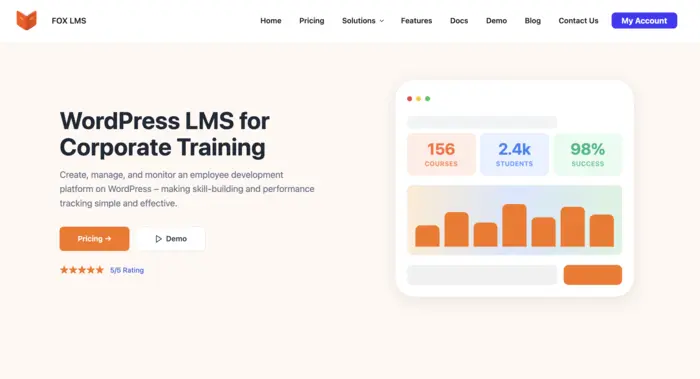
FoxLMS helps organizations to build training programs without overcomplicating the process. It runs directly on WordPress, which means companies maintain ownership of their data, branding, and system configuration instead of relying on SaaS platforms.
For corporate training teams, that translates into practical flexibility.
For example:
If onboarding changes next quarter, the learning path can be adjusted immediately. Compliance documentation needs restructuring, reporting fields can be modified without waiting on external support. Leadership wants deeper analytics, dashboards can be configured around internal KPIs rather than generic templates.
That level of control matters in growing organizations.
FoxLMS supports typical corporate training use cases such as:
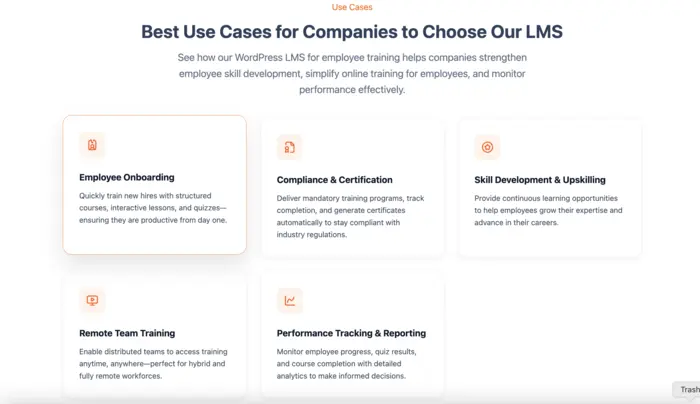
- Role-based learning paths
- Certification tracking and renewals
- Quiz and assessment management
- Course progress monitoring
- Reporting dashboards for HR and leadership
- Department-level access controls
Because it integrates within WordPress, it also connects smoothly with CRM systems, HR tools, and internal workflows that many companies already use.
Another important factor is scalability. Corporate training programs rarely stay static:
- Companies expand into new markets
- Add departments
- Launch new products
- Introduce new compliance requirements
A rigid system slows that growth.
FoxLMS is structured to evolve with those shifts. Courses can be duplicated and adjusted. Departments can be segmented. External partner portals can be created without building separate systems.
For organizations that prefer maintaining ownership of their infrastructure rather than renting it, this model provides long-term flexibility.
Security is another consideration. Since FoxLMS runs within a controlled WordPress environment, access permissions and data governance remain under company oversight. That’s particularly relevant for industries handling sensitive employee or certification records.
What stands out most, however, is operational clarity.
FoxLMS does not attempt to overwhelm teams with unnecessary complexity. Instead, it focuses on core enterprise training functions, such as:
- Structure
- Reporting
- Automation
- Controlled scalability
For corporate teams that want:
- Structured onboarding
- Documented compliance
- Upskilling visibility
- Certification management
- Performance-aligned reporting
FoxLMS becomes less of a “learning tool” and more of a structured workforce system.
And for organizations already operating within WordPress ecosystems, implementation friction is minimal.
Final Perspective
Corporate training LMS use cases extend far beyond online courses.
They shape onboarding systems, compliance processes, leadership development, partner education, and workforce analytics.
For enterprise teams, an LMS supports operational clarity.
It replaces fragmentation with structure.
And in growing organizations, structure often becomes the difference between controlled growth and operational friction.