People usually view learner engagement as a target but they do not approach it as a systematic field of study. Organizations spend money on learning platforms, LMS plugins, content libraries and training programs yet their employees fail to finish courses and do not gain deep knowledge and cannot apply what they learned in practical situations.
The main distinction between these two options depends on user participation levels.
Learning experiences become more effective when people show interest through their interactions which determine their focus levels, their drive to learn and their ability to use acquired knowledge.

The level of learner involvement in learning activities determines their mental and emotional engagement in educational activities. The indicator shows how students experience their learning process because it measures their actual learning activities instead of their attendance or course completion.
An engaged learner actively thinks about what they’re learning, connects ideas to prior experience, asks questions, and tests understanding. A student who is not engaged with their learning will finish their work but they will not actively participate in the process which results in poor understanding and minimal practical application.
The way students engage with their learning depends on their specific situation. Students from the same group show different levels of involvement between their two courses. The factors which determine engagement include:
- The degree of relevance
- The learning design structure
- The speed of delivery
- The quality of feedback
- The specific targets learners want to achieve.
Learning engagement provides educators and organizations with essential information about whether their educational programs deliver actual learning benefits or simply generate student participation.
Why Learner Engagement Matters
The level of student involvement in their learning activities determines how well they will achieve their academic goals. The success of well-made content depends on audience participation because insufficient engagement makes all content efforts unsuccessful. Learning becomes durable and applicable when students show high levels of engagement.
Improved Learning Outcomes
Students who show interest in learning activities understand information at a higher level. The audience members use content instead of passively receiving it. The process results in improved knowledge retention which produces enhanced memory recall abilities that lead to superior performance during academic evaluations and practical applications.
The student engagement success research shows that students who stay engaged in their educational programs achieve better learning results, finish their studies at higher rates in training programs.
Stronger Skill Development
People learn new skills by doing them repeatedly while receiving guidance from others and thinking about their performance. Training engagement enables learners to try new things while they learn from their errors which helps them develop their skills. Learning becomes theoretical when students do not engage with their education because it fails to connect with actual situations.
Workplace learning requires special attention because its main objective involves performance enhancement instead of basic knowledge transfer.
Higher Motivation and Confidence
The way people experience learning depends on their level of involvement in the learning process. Learning success depends on student involvement and teacher support which helps students develop their confidence in their academic development. Learning becomes purposeful rather than mandatory.
Support for Lifelong Learning
The development of habits which go past single courses becomes possible through student engagement. Students who experience meaningful engagement will keep learning independently while they adapt to changes and make investments for their future development.
Continuous learning becomes a key business benefit which organizations can use to gain competitive advantage in fast-changing markets.
Types of Learner Engagement
There are three overlapping elements which make up learner engagement as a single concept. The three student engagement types show how students engage with educational content through their learning activities.
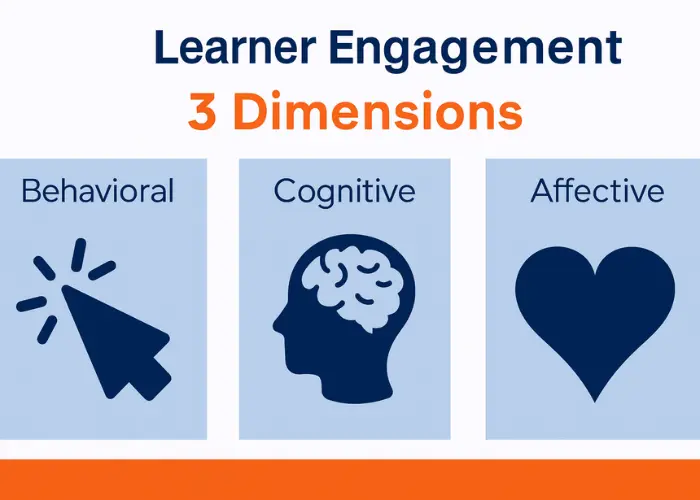
Cognitive Engagement
Cognitive engagement describes the level of mental work students dedicate to their learning process. The process requires students to perform analysis work and solve problems and reflect on their work and make decisions.
Students who demonstrate cognitive engagement make an effort to understand the operational principles of something beyond its basic identity.
The application of concepts to different scenarios along with the practice of questioning established beliefs and the analysis of received feedback constitute examples.
Behavioral Engagement
Behavioral engagement focuses on observable actions. The category includes all activities which students need to do such as:
- Completing their work
- Participating in discussions
- Interacting with content
- Finishing their assignments
Behavioral engagement by itself does not ensure deep learning but it does indicate that students are participating instead of being uninterested.
Emotional Engagement
Students develop emotional involvement with their learning activities through their personal reactions to educational experiences. The way students interact with their learning materials throughout time depends on their interest level, their curiosity, their confidence, their frustration and their feeling of being part of the learning environment.
Students will continue their learning when they develop emotional connection to the material because complex and challenging subjects require their dedication.
Strategies to Foster Learner Engagement
The process of enhancing student participation does not need major transformations or nonstop entertainment. Most learning outcomes improve when designers create thoughtful systems which honor students’ time commitments and their established objectives.
Make Learning Relevant
The level of engagement people show depends most heavily on how relevant the content is to them. Students become more interested in their learning when they understand how their education relates to their professional responsibilities, their personal objectives and everyday problems.
Personalization serves as an essential element for this process. Learning paths that adjust to individual skill levels, professional roles and current progress enable students to concentrate on their most important learning objectives.
Encourage Active Participation
People learn new things only when they actively engage with content instead of simply watching it. The course includes interactive elements which consist of brief exercises and scenarios and reflection activities and knowledge assessment questions that help students engage with the material.
The learning process benefits from these interactive moments because they help students stay engaged without creating excessive mental strain or interrupting their work.
Support Social Learning
Learning becomes more effective when students have opportunities to share their different points of view. The process of discussions and peer feedback and collaborative tasks helps students develop their ability to reflect while they maintain their sense of accountability.
Social learning doesn’t need to be complex. The educational process becomes more engaging through basic opportunities which students can use to interact with each other.
Connect Learning to Real Situations
Students become more interested in their learning when they can use classroom concepts to solve actual situations. The combination of case studies, practical examples, role-based tasks enables students to connect theoretical knowledge with real-world implementation.
The training method delivers its best results in engagement programs because students need to see immediate connections between their learning and their work performance.
Provide Continuous Feedback
Feedback helps students stay focused while maintaining their drive to learn. The delivery of immediate helpful feedback enables students to track their development while they learn to fix their errors and maintain their interest in the material.
Feedback enables educators and organizations to understand learner behavior which helps them create better learning experiences through their feedback analysis.
Challenges in Fostering Learner Engagement
Learning programs which have proper design still encounter problems that affect student participation.
Students need to overcome technology obstacles which block their learning process at the start of their educational journey. The use of one-size-fits-all educational methods fails to work because students have different learning needs.
The solution to these problems needs organizations to stay adaptable while maintaining open dialogue and they should focus on ongoing development instead of using fixed design approaches.
The Role of Learner Engagement in Online Learning
Online learning spaces require learners to stay actively involved because engagement stands as their most important factor. Students who learn without being present in the classroom need structured learning activities and interactive sessions and feedback systems to stay concentrated.
Programs which focus on learner involvement will experience:
- Higher completion rates
- Better knowledge retention
- Stronger learner satisfaction
- More consistent skill application
Education requires student participation to achieve both accessibility and effective learning outcomes in online educational programs.
Conclusion
The goal of learner engagement goes beyond providing entertainment because it requires students to participate in meaningful activities. The process involves designing educational activities which help students learn and acquire abilities that result in practical achievements.
Learning becomes more effective when students remain engaged because they absorb information better and maintain their knowledge for longer periods while demonstrating better skill application.
Educators, trainers, organizations need learner engagement as their fundamental necessity to achieve learning success.
FAQ
What is learner engagement?
The extent of learner involvement in learning activities determines their level of engagement through their mental dedication and active participation and emotional investment.
Why is learner engagement important?
The process of engagement leads to better learning results while helping students build their abilities and making them more interested in their work and enabling them to remember information for extended periods.
What strategies exist to enhance student participation in learning activities?
The combination of relevant content and active student involvement and social learning approaches and practical applications and ongoing assessment feedback leads to better student engagement.
Is learner engagement the same as participation?
No. The visible actions in Participation do not match the complete cognitive and emotional dedication which defines learner engagement.