Every company seems to acknowledge it now: skills become irrelevant quicker than job names change.
Instead of waiting for problems, companies now invest in upgrading skills and relearning fast. Far from old-style classroom courses, these efforts reflect smart planning in unpredictable times. By protecting internal expertise, firms gain room to shift direction without endless job postings.
When change happens around people, upskilling and reskilling makes companies stop hiring by job title. They start wondering: what skills sit inside the team – right now – and where might those grow?
Learning stays alive when this method is used. Work gets better because people adapt faster. Tension inside the organization fades slowly.
What Is Upskilling and Reskilling?
Even though people talk about them as if they’re the same, each tackles a separate challenge in companies.
Upskilling
What happens when employees gain more depth or variety within their current abilities? That is upskilling. The job itself does not become outdated – only its demands shift over time. Learning fresh software could be part of it. So might adopting smarter ways to do things. Even picking skills that fit alongside original ones serves a purpose. All these steps aim to make performance sharper and more useful.
Take these cases
- A project manager building skills in agile or change management
- A sales professional learning CRM automation and data analysis
Reskilling
When old jobs fade, skill renewal steps in. Employees gain entry to fresh positions – not replacements but replacements themselves. Experience shifts direction rather than vanishing overnight. Firms transfer internal talent toward emerging needs instead of discarding it.
Take these cases
- Administrative staff retrained for operations or compliance roles
- Manufacturing employees transitioning into quality control or technical support
What happens when skills get updated? Put simply, upskilling means building on what you already know to go further in your job. Reskilling takes it another direction – it’s about learning entirely new things, often because technology changed or opportunities shifted. So if someone presses you for details, you can just say it like this:
- Upskilling preserves relevance within a role
- When people update their skills, the worth stays present in most positions
What Are the Key Benefits of Upskilling and Reskilling?
Improved knowledge retention
A surprise perk of learning new job skills? It reshapes how we pick things up. Since practice connects directly to actual work needs and future roles, involvement grows stronger. Information sticks around far better when used this way.
Learning doesn’t stop after a single workshop. Over time, abilities grow through repeated practice and review. Employees pick up techniques, test them, adjust, then repeat.
Less money spent on employee training
Professionals outside the company usually seem quicker in theory yet tend to miss key drawbacks – hiring takes months, newbies arrive late, fit with team feels off, and people leave fast.
When employees gain new skills, some dangers shrink. Reusing what staff already know helps them jump into tough roles faster. Their output climbs sooner than if training began from zero. As years pass, leaning less on endless job ads makes planning easier. Stability grows because learning spreads across teams.
Every now and then, new data from the World Economic Forum shows that teaching employees new skills beats hiring someone entirely – it just plain works better on budgets.
Improved employer brand and reputation
When a company spends on continuous learning, it signals where things are headed. People inside start seeing their own path forward too. Growth feels shared, not forced.
What counts is that top professionals now judge jobs by how much they learn, not only pay. Firms with solid learning cultures pull in people driven by purpose, able to adjust quickly, focused on future goals.
Fewer knowledge shortages exist
Suddenly, skills aren’t enough when technology updates leave behind old ways. What worked yesterday now lags behind without learning what came after.
When people grow new skills, problems often stop before they start. Teams stay closer to company goals this way, while leaders lower the chance of avoidable setbacks.
The Difference Between Upskilling and Reskilling
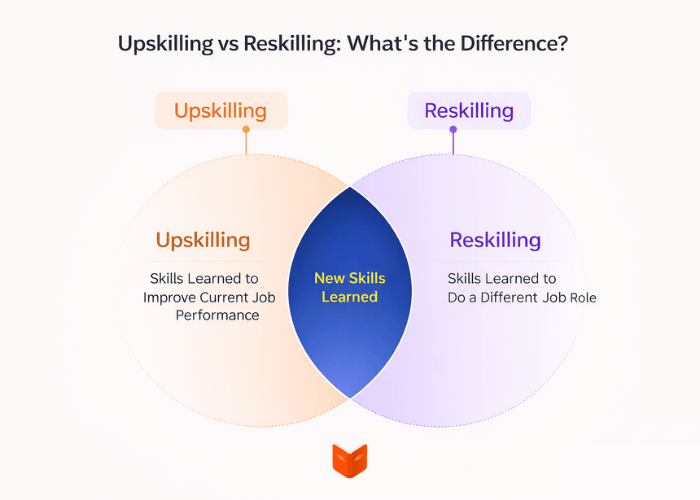
What sets upskilling apart from reskilling isn’t rank or priority – it comes down to when it happens and why it’s needed.
Upskilling works best in these situations:
- Even though roles still matter, they need updating for today’s context
- Performance expectations are increasing
- People joining work places are increasing over time
Reskilling works best under these conditions:
- Nowadays how companies operate is shifting in ways no one saw coming.
- Some jobs are disappearing while others are combining into new ones
- Some companies aim to keep skilled employees even when plans change. Retaining talent becomes a goal during major shifts in strategy
Take learning a fresh coding setup – that counts as getting better. Helping tech people shift into building full features? That’s rebuilding skills entirely.
When companies grasp this difference, they stop throwing effort into places it does not fit – putting corporate training to work where results matter most.
The Importance of Upskilling and Reskilling for Employees
Looking at things through an employee’s point of view, growing skills isn’t just helpful anymore – it helps stay safe during change.
Staying sharp at work keeps employees aligned with today’s job demands. When industries shift, rebuilding skills allows people to move into new roles inside the same company.
Beyond job security, these practices support:
- Career mobility without job-hopping
- Engagement climbs when progress feels real. Growth that matters pulls people in, shaping how they connect and stay involved.
- Increased confidence in navigating change
When employees treat learning as normal work, they adjust better, welcome shifts easier, yet still care about results.
The Importance of Upskilling and Reskilling for Organizations
When companies shift needs, teaching new skills – or reteaching old ones – becomes a way to adapt smartly.
They make it possible for leaders to:
- Respond faster to market shifts
- Reduce disruption during transformation
- Preserve institutional knowledge
- Encourage cross-functional collaboration
Skills move freely between groups, not locked into fixed positions. When work shifts, teams adapt easier because roles are loose, not fixed. Ideas spread faster because people connect across functions, breaking down barriers. Change becomes less disruptive when structure follows needs instead of rules.
How to Approach Upskilling and Reskilling for Employees
Provide access to affordable online learning platforms
When built right, learning systems help teams grow without hiccups. Centralizing insights becomes easier this way, progress stays visible, goals tie to company direction.
Some firms choose a WordPress LMS plugin when building training programs for employees, letting on-site learning evolve with team size.
Shift turn managers toward coaching and mentoring roles
Most training efforts collapse if bosses see them as afterthoughts. Should executives step in to guide, share observations, then back growth of abilities, progress turns routine – no longer added pressure.
Create collaborative learning and study groups
When people learn together through shared knowledge, ideas spread faster while common ground forms naturally. Instead of waiting for official courses, teams might host small workshops or exchange notes after meetings. Shared work on real tasks – like shared goals or team-led initiatives – helps shape expectations without lectures. Sometimes, simply checking in regularly between shifts sharpens skills more than any book.
Set out what abilities and support matter most here
When things are unclear, studying drifts without direction. Companies need to say what skills count today, which will count tomorrow, then track every step forward.
What matters is how training lines up with actual job needs. Learning pays off when it builds useful skills straight away.
Embrace mobile and flexible learning formats
Where people work, short lessons fit best when delivered through phones. Learning shows up where tasks do – built right into daily routines. Different ways to consume it pull more folks in, matching how time gets used.
Conclusion
Nowadays, learning new skills isn’t just something companies do – it’s what keeps them running at all.
These let companies keep key people, shift direction quickly, while developing skills – over time – that go further than one person can provide. From an employee’s point of view, there is room to advance, feel stable, stay connected – even when things change suddenly around them.
FAQ
1. What is upskilling and reskilling?
When people build on what they already know, their abilities grow within today’s job demands. Shifting tasks or industries requires more than learning – it rewires experience to fit changing company goals.
2. Why are upskilling and reskilling important for companies?
They close skill gaps, cut hiring expenses, yet allow businesses to shift rapidly when conditions change.
3. How do organizations decide between upskilling and reskilling?
Change happens when jobs grow in skill, then pick the right option. Otherwise, skills shift because roles vanish or change completely.
4. Does learning new skills or updating job abilities help employees stay longer?
That’s right. When employees see where they’re headed, they tend to stay longer, care more about their role, sometimes even speak up. Growth shows on the screen from inside.
5. What is the first step to implementing upskilling and reskilling?
Begin by spotting key abilities tied to company objectives – next, shape training routes around those needs.